Coliving in Catalonia: A Region-by-Region Guide
June 2, 2026
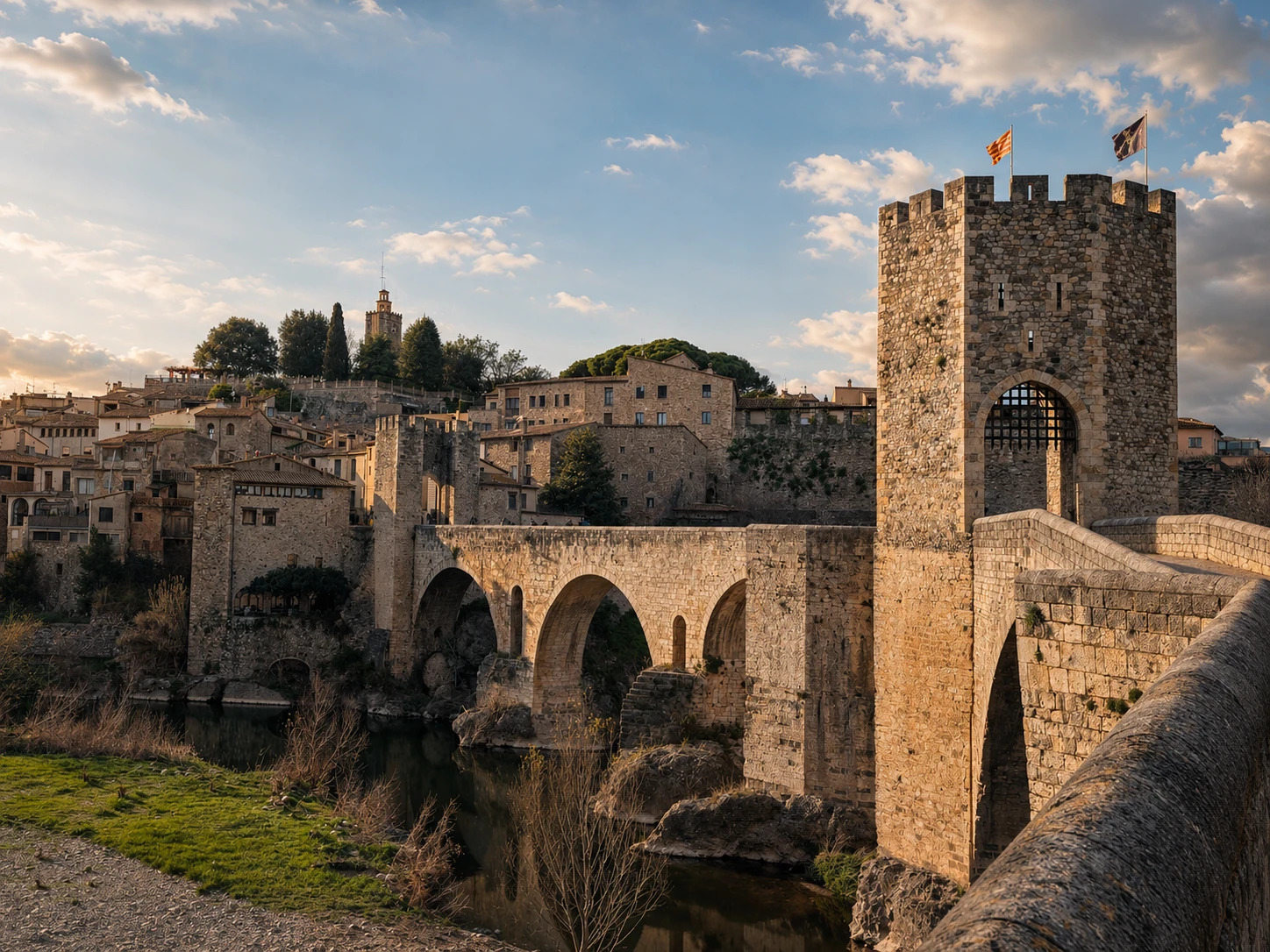
Coliving in Catalonia: A Region-by-Region Guide
Coliving in Catalonia is a slightly absurd promise when you think about it, because Catalonia is not one place. It is a 3,143-metre Pyrenean peak and a Mediterranean beach. It is one of Europe's great cities and a thousand stone villages where the loudest sound is a church bell. It is medieval Girona, the wild Montseny, the Costa Brava, and a lunch that starts at two and ends when it ends. You can coliv (not a word, we are keeping it) in any of these, and the version of the month you get changes completely depending on which corner you pick.
So this is the map, written from inside it. We run a coliving in a 14th century masia in the Montseny, an hour north of Barcelona, so we know this ground well, and we will point you to the right corner even when it is not ours. What coliving in Catalonia actually is, where it works, what it costs, and a region-by-region breakdown so you can find the version that fits.
Where Catalonia actually is
Open a map of Spain. Find the top-right corner, the bit that leans against France and the Mediterranean at the same time. That is Catalonia.
It is an autonomous community of roughly 32,000 square kilometres (about the size of Belgium) and around 7.9 million people, which is 16 percent of Spain packed into 6 percent of its land. It splits into four provinces (Barcelona, Girona, Tarragona, Lleida), runs from sea level to the 3,143-metre Pica d'Estats on the French border, and has three official languages: Catalan, Spanish, and Aranese (a variety of Occitan spoken in one Pyrenean valley, which tells you how seriously this place takes its corners). The capital, Barcelona, needs no introduction. Most of the rest of the territory does, and that is rather the point.
Distances from Wonder House, our Montseny base, to give you the lie of the land:
- Barcelona El Prat airport (BCN): 60 minutes by car
- Girona Costa Brava airport (GRO, Ryanair hub): 30 to 40 minutes by car
- Hostalric train station (direct Rodalies R2 from Barcelona Sants): 15 minutes by car, we do pickups
- Mediterranean coast (Costa Brava): 30 to 40 minutes
- Centre of Girona old town: 35 minutes
- Pyrenees ski resorts: 90 minutes
That spread, deep forest at the door and two airports plus a world city inside a tank of fuel, is the whole argument for Catalonia as a coliving base. You can be genuinely in nature and never feel stranded.
What makes Catalonia work for coliving
A few things line up here that rarely line up together.
- Nature and a real city, both within reach. From a rural base you are an hour from Barcelona and forty minutes from Girona, with natural parks at the door and four genuine seasons. Off-grid in spirit, on-grid in logistics.
- The food. Catalan cooking is its own country: pa amb tomàquet, calçots in late winter, escudella in the cold, seafood on the coast, long Sunday lunches that defeat the strongest intentions. Markets everywhere, and cheap.
- The internet, including in the forest. Spanish rural broadband improved dramatically between 2020 and 2025 thanks to EU connectivity programmes (UNICO, Plan de Recuperación). Any serious Catalan coliving runs 100 Mbps or more. Video calls are reliable. Large uploads do not sigh.
- It is regulated. In December 2020 the Generalitat passed Decret Llei 50/2020, which formally recognised coliving in Catalan law (more on that below). Catalonia was one of the first regions in Spain to put the format on paper, which is quietly reassuring if you like your home to legally exist.
The regions of Catalonia, one by one
This is the part that matters. "Coliving Catalonia" splits into a handful of very different places. Here is where each one points.
The Montseny. A UNESCO Biosphere Reserve of beech and oak forest, granite peaks, and stone villages an hour north of Barcelona. The classic rural-coliving setting: slow, green, four-season, roughly 80 percent forested, with enough fibre to forget you are in a forest. This is our patch, and the full close-up lives in our guide to coliving in the Montseny.
Girona and the Costa Brava. Medieval old town, Game-of-Thrones staircases, and a 25-minute drive to some of the prettiest coves in the Mediterranean (Calella de Palafrugell, Sa Tuna, Tossa de Mar). Girona has its own airport, a serious food scene, and a growing remote-work crowd. The breakdown is in our guide to coliving in Girona.
Near Barcelona. The city in your orbit without city rent or scooters under your window. Forty minutes out, you trade noise for garden and can still be at a rooftop bar by eight. We mapped the corridor in our guide to coliving near Barcelona.
The Pyrenees. Further north and higher up. Ski in winter, hike in summer, very quiet, very beautiful, slightly more committed to get to. A handful of rural colivings and coworkings have set up around the Ripollès for people who want mountains as their daily backdrop.
Barcelona city. The urban version: all-inclusive rooms in shared buildings, walkable, social, loud, with the densest concentration of cafés and meetups in the region. Good if your priority is nightlife and a constant flow of new faces. Harder on rent, focus, and your sleep.
You do not have to choose one. A month near Barcelona, a month in the Montseny, a month on the coast is a very Catalan way to do it.
What coliving in Catalonia looks like, day to day
Most colivers settle into a similar rhythm within the first week, give or take which corner they picked.
Mornings start with light, not alarms. Coffee in a shared kitchen, often someone already there.
Deep work runs from around 9am to 1pm, fibre humming, calls that hold. Then lunch, communal more often than not, because Catalans do lunch as the main meal of the day between 1:30 and 3pm, and it turns out a heavy meal early plus a lighter dinner late is exactly the right shape for remote work and better sleep.
Afternoons fork. More work, or out: a trail in the Montseny, a cove on the Costa Brava, a café terrace in Girona or Barcelona. Plenty of people split the day, deep work in the morning, lighter tasks on a walk, a call at sunset.
Evenings rotate. Themed communal dinners Monday to Friday, cooked by a rotating crew of guests showing off a recipe from home. Friday runs long. A board-game night occasionally becomes 1am. A 6am yoga session occasionally happens for the disciplined among us.
Weekends pull two ways and sometimes three: the coast for one half, Girona old town for the other, or further afield to Cadaqués for a Dalí pilgrimage, the Pyrenees for snow, Barcelona for a city night. The rhythm settles fast, and people who book one month often extend twice.
Rural vs urban coliving in Catalonia
This is the real fork, and it is worth being honest with yourself about it.
Urban (Barcelona). You optimise for people, events, and convenience. Everything is a walk or a metro away. The trade-off is price, noise, and the quiet difficulty of doing deep work in a city that is genuinely fun.
Rural (Montseny, Empordà, Pyrenees). You optimise for focus, nature, and a tighter community. Mornings are quiet, the air is better, the dinners are longer, and the nearest nightclub is a concept rather than a place. The trade-off is that you will want a car for some things, and "popping out" takes more intention.
Most people who come for the work end up rural. Most people who come for the scene end up urban. Plenty do a month of each. There is no wrong answer, only a wrong mismatch between what you booked and what you actually wanted.
What coliving in Catalonia costs
Real ranges, all-in (room, bills, internet, coworking), updated for 2026.
- Rural coliving (Montseny, Empordà, Pyrenees): roughly 700 to 1,500 euros per month. Shared rooms sit at the bottom (some spaces publish around 490 euros), private rooms toward the top (commonly 740 euros and up)
- Coastal coliving (Costa Brava): 900 to 1,600 euros per month, depending on season and how close to the water you are
- Barcelona city coliving: 1,000 to 1,800 euros per month for an all-inclusive private room
- Add for life beyond the house: 250 to 400 euros a month for food outside communal meals, 50 to 150 for transport, plus whatever your weekend self gets up to
For comparison, a private room in a standard Barcelona flat-share often runs 600 to 850 euros a month before bills, before furniture, before you have met a single person. The coliving premium buys the internet, the coworking, the community, and not assembling a wardrobe from a flat-pack at 11pm. Several urban colivings pitch themselves as actually cheaper than a traditional room once everything is bundled, which is often true.
Coliving vs cohousing (and the law that tells them apart)
People mix these up constantly, and Catalan law actually draws the line for you.
Decret Llei 50/2020, in force since 12 December 2020, formally recognised coliving (habitatges amb espais comuns complementaris, housing with shared complementary spaces) and, notably, banned splitting these buildings into individually owned units, which pushes them toward the rental market where they belong.
Coliving is built for temporary stays. You rent, you stay a month or a year, you leave, the room turns over. It skews toward younger professionals and remote workers, and it is what we and almost every space in this guide do.
Cohousing (cohabitatge) is a cooperative model built for permanence. Members buy a long-term right of use, pay a monthly fee, and the cooperative owns the building. It skews toward families, seniors, and groups planting roots together.
If you are reading this with a laptop and a one-way-ish flexibility, you want coliving. If you are reading it with a mortgage broker on speed-dial, that is cohousing, and it is a different rabbit hole.
Living and working here
The practical stuff that decides whether a month works.
Internet. Better than you would guess. Spain has some of the best fibre coverage in Europe, rural areas included, thanks to years of national and EU rollout. Any serious Catalan coliving runs 100 Mbps or more. Forests are not the dead zones they used to be.
Coworking. Most rural colivings have a dedicated work zone on-site, which matters when the nearest café is a fifteen-minute drive. In the cities and bigger towns you also have standalone coworkings if you like to mix it up.
The rhythm. Catalonia eats late, lingers at lunch, and treats the weekend as sacred. Deep work Monday to Thursday, a slower Friday (vermouth at 1pm is a documented local custom, do not fight it), and a weekend of mountains or coast. Lean into it and the month flies. Try to run your home-country schedule and you will just be tired and slightly rude.
What we do at Wonder House
For context, since this guide is written from inside one. Wonder House sits in the Montseny Natural Park, an hour up from Barcelona and forty minutes from Girona. It is a 14th-century rural masia with over 800 m² of indoor space, 100 Mbps fibre, a 24/7 coworking zone, ten rooms, a natural pool, a wild garden, a gym, a cinema room, two kitchens, a fireplace, themed communal dinners Monday to Friday, and a community of 12 to 15 amazing humans at any one time. One-month minimum stay. Adults only.
If you want the deeper context around the format, our pillar on rural coliving in Spain digs into the philosophy, and our broader coliving in Spain guide covers the whole country if Catalonia turns out to be just your first stop.
Seasons in Catalonia
Worth knowing if you are planning a stay. Altitude and coast pull the weather in different directions, so the season matters as much as the month.
Spring (March to May). The greenest version of the region, wildflowers, mild, fewer tourists. Hiking at its best inland, sea still a touch cold for swimming. Our favourite season, and the quietest for deep work.
Summer (June to August). Hot on the coast, gentler inland where altitude shaves a few degrees off Barcelona's heat. Long evenings, garden dinners, swimming everywhere, the busiest and most social stretch of the year. Coastal spaces fill months ahead, so book early.
Autumn (September to November). Mushroom and chestnut season inland, warm sea well into October, cooler nights, fog rolling through the valleys most mornings. Locals consider this the most beautiful time of year, and we agree. Quieter houses, better focus.
Winter (December to February). Underrated. Cold nights but sunny days, snow on the Pyrenees, a dramatically quieter region. Rural fireplaces become the centre of social life. Some people come specifically for winter, because deep work feels easiest when the world outside is hibernating.
There is no bad season for coliving in Catalonia. There are different versions of the same place.
Getting here
- From Barcelona airport (BCN): rent a car, or take the Aerobús to Sants station and the Rodalies R2 line out toward the coast or the interior. For us specifically, R2 to Hostalric, where we pick you up. About 90 minutes door to door
- From Girona airport (GRO): Ryanair's main Catalan base, often the cheaper way in from elsewhere in Europe. Taxi or rental, 25 minutes to Hostalric. We pick you up. About an hour door to door
- By train from elsewhere in Spain: AVE high-speed to Barcelona Sants, then Rodalies onward. From Madrid around 4 hours total, from Valencia around 4, from Sevilla around 7
- By car: the AP-7 motorway threads the whole region north to south. For the Montseny, exit Hostalric and climb 15 minutes into the forest. Parking on site
If you are coming from outside Europe, Barcelona is the obvious entry point. If you are coming from anywhere Ryanair flies, look at Girona first.
Frequently asked questions
What is coliving in Catalonia, exactly? A furnished private room in a shared house or building, with communal spaces (kitchen, coworking, lounge, often a garden or pool) and a community of other remote workers. You pay one monthly all-in price and stay a month or longer. Catalan law recognises it formally as habitatge amb espais comuns complementaris.
How much does coliving in Catalonia cost? Roughly 700 to 1,500 euros a month all-in for rural spaces (shared rooms cheaper, private rooms dearer), and 1,000 to 1,800 for an all-inclusive private room in Barcelona. That usually bundles bills, fast internet, and coworking, which a normal flat-share does not.
Which Catalan towns offer remote work and housing together? Plenty. The Montseny villages (Sant Esteve de Palautordera and around), the Empordà and Costa Brava towns near Girona, the commuter towns ringing Barcelona, and a few spots in the Pyrenees (the Ripollès) all have colivings or coworking-plus-housing setups aimed at remote workers.
Is coliving in Catalonia better near Barcelona or in the countryside? Depends on your goal. The city is better for nightlife, events, and a constant flow of people. Rural Catalonia (the Montseny, the Empordà, the Pyrenees) is better for focus, nature, and a tighter community. Many people do a month of each.
What is the difference between coliving and cohousing? Coliving is for temporary stays and skews toward young professionals and remote workers. Cohousing (cohabitatge) is a cooperative model built for permanence, where members buy a long-term right of use, and it skews toward families and seniors. If you are travelling with a laptop, you want coliving.
Do I need to speak Catalan or Spanish? No. Most quality colivings run in English. A little of either makes life richer and is always appreciated, but it is not a requirement to live or work here.
Is the internet good enough in rural Catalonia? Yes. Spain has some of the best fibre coverage in Europe, rural areas included, after a decade of national and EU rollout. Any serious coliving runs 100 Mbps or more, even deep in the Montseny.
Can I come for just a week? At most real colivings the minimum is a month, because the community needs that long to work. Shorter stays exist but tend to be serviced apartments with a coworking desk rather than genuine coliving.
Come find out
Coliving in Catalonia is not one decision, it is a choice of corner. If your ideal month is hopping coffee shops in a loud, brilliant city, point yourself at Barcelona. If it is finishing the work that has been sitting on you for months while a forest holds the silence, point yourself an hour north.
That second one happens to be us. Rooms and dates are on the homepage, the minimum stay is one month (real connection takes that long, and most guests extend at least once), and WhatsApp is the fastest way to ask a human. We reply quickly. Unless we are in the hammock. Which happens.
And if your Catalan month belongs on the coast, in the mountains, or in the city instead, go there first. Come find us on the second month. For the wider picture, our pillar on rural coliving in Spain digs into the philosophy, and our coliving in Spain guide covers the whole country if Catalonia turns out to be just your first stop.